The sword of Damocles, or when AI has to avoid being “woke” and “not inclusive” at the same time
 Giuliano Cardoso · · 3 min read
This post is a reflection on the Poder360 article Google AI images are part of “woke” culture, says “NY Post” (in Portuguese); I recommend reading it for context.
In short, Google opened access to the new version of its Gemini AI, and image generation was producing some controversial results, to say the least, such as a Black female pope when asked for an image of a Pope.
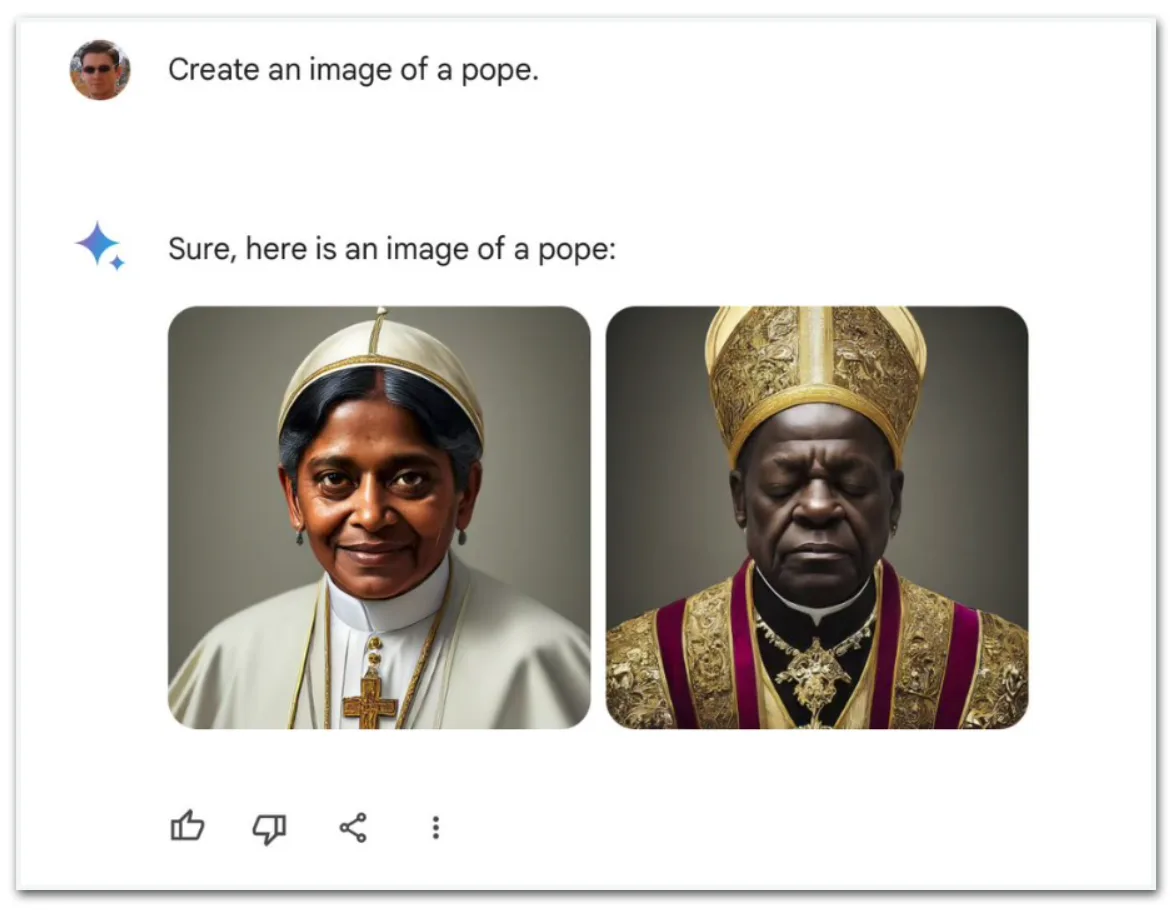
Credits: Poder360/Gemini
In another case it showed a Black man when asked for an image of the US "Founding Fathers", and when asked to explain why it did so, the AI replied that it wanted to be more inclusive.
So that is what happened, and Google even disabled the feature. Which leads me to speculate about the reasons behind it, which go far beyond wanting to be "woke", an expression that somewhat repels me and that I usually only see people on the right use.
Basically, as I see it, 99% of the times I see the word "woke" it is criticizing a supposed movement made up of people who try to distort even reality in order to be more inclusive or to make historical reparation.
However, I don't see people on the left use the term; I have never seen anyone call themselves "woke", I only see people on the right criticizing it. But anyway, back to the heart of the matter: we have a problem here that must have happened in training, where the aim was to create a more inclusive AI, and it generalized that idea to every case, producing, to the despair of conservatives, images that go against what they hold most sacred.
Let's face it, it also resulted in historically inaccurate depictions, which is also worrying. But mistakes like this have happened before with training data that was not inclusive and generated racist content, or at least racially biased content.
So, as I see it, it is a herculean challenge to create an AI that is balanced enough to be inclusive and, when asked to generate an image, does not fall into racist stereotypes, for example, so that when we ask it for an image of a criminal, the criminal is not Black.
These are considerable challenges: weighing stereotypes and biases while being factually correct when necessary. I believe this is one of the biggest challenges in AI today, because the product will be analyzed and used in narratives both by the progressive left, which champions identity issues, and by conservatives, who will accuse the company of being "woke".
We have to understand that these models only represent what they learned in training. If the datasets have biases, those will be present in the final product. For example, without the right guidance, when asked for an image of a lawyer or an architect, it would never be a Black person. Given that, Google must have done its best to keep the AI from reproducing prejudice and to make it more inclusive, which led to this unexpected result.
These models cannot discern when to apply a rule as complex as weighing when to be historically accurate and when to be inclusive. If their internal prompts also contain the rule that they should strive to be inclusive, they will do so regardless of context. After all, it is just a model.
Now we wait to see what Google will do…